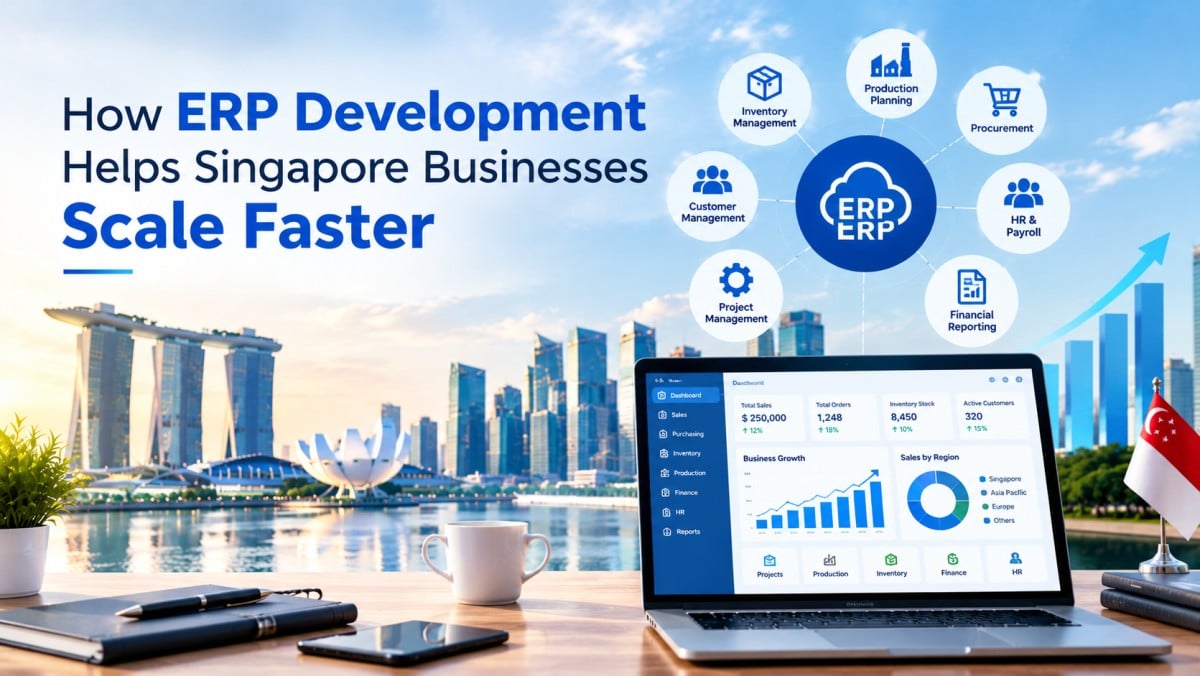
How ERP Development Helps Singapore Businesses Scale Faster
Business growth brings new opportunities, but it also creates operational challenges. As companies expand their teams, serve more customers, and manage higher transaction volumes, existing systems may struggle to keep up. Disconnected applications, manual reporting, and inconsistent data can slow down daily operations and make business decisions more difficult.
This is where ERP Development in Singapore can help. Enterprise Resource Planning (ERP) software connects essential business functions through a centralized platform, allowing companies to manage information, automate workflows, and coordinate resources more effectively.
For growing Singapore businesses, the right ERP solution can provide a stronger operational foundation and make expansion easier to manage.
Why Is ERP Development Important for Business Growth?
When a business is small, spreadsheets and separate applications may be sufficient. However, as operations become more complex, these tools can create information gaps between sales, finance, inventory, purchasing, and customer service.
ERP Development brings these functions together, helping employees access consistent information and reducing the need for repetitive administrative work.
A well-planned ERP system can help businesses:
- Improve coordination between departments.
- Automate routine business processes.
- Monitor expenses, revenue, and inventory.
- Generate reports using centralized information.
- Manage additional customers, employees, and locations.
- Make decisions based on more reliable operational data.
These improvements help companies prepare for growth without allowing administrative complexity to increase at the same pace as their operations.
6 Ways ERP Development Helps Singapore Businesses Scale Faster
1. Automates Repetitive Business Processes
Manual activities such as invoice preparation, purchase approvals, order processing, and report generation can consume significant employee time.
ERP software allows businesses to configure workflows that automate suitable tasks. For example, an approved purchase request can trigger a purchase order, notify the relevant department, and update purchasing records.
Automation reduces repetitive work and helps employees focus on customer service, planning, and other activities that contribute to business growth.
2. Connects Departments Through Centralized Data
Business expansion often leads to the introduction of additional tools and applications. Without proper integration, departments may maintain separate records that do not always match.
An ERP system connects business information across departments. Sales teams can access relevant stock information, finance teams can review transactions, and managers can monitor operational performance through shared reports.
This connected approach improves communication and reduces delays caused by searching for information across multiple systems.
3. Improves Inventory and Supply Chain Management
Businesses involved in manufacturing, retail, and distribution need accurate information about stock availability, supplier orders, and product movements.
ERP Development can support inventory tracking, warehouse management, purchase planning, barcode scanning, and stock replenishment.
For companies managing multiple warehouses or serving customers across different markets, these features can improve inventory visibility and help reduce stock shortages.
Better purchasing and stock planning can also limit unnecessary inventory accumulation, helping businesses manage working capital more effectively.
4. Strengthens Financial Planning and Reporting
Growing companies need a clear understanding of revenue, expenses, cash flow, and profitability. When financial information is spread across different applications, preparing accurate reports can become time-consuming.
ERP software connects financial records with sales, purchasing, inventory, and project activities. Depending on the selected platform, businesses can generate reports covering outstanding invoices, operating expenses, budgets, and financial performance.
This information helps management identify cost pressures, review business performance, and plan future investments with greater confidence.
5. Supports Expansion Into New Markets
As companies enter new markets or establish additional locations, they may need to manage different teams, currencies, reporting requirements, and business processes.
A scalable ERP solution can support multiple locations, centralized reporting, and appropriate access permissions. Depending on the platform, it may also offer multi-currency accounting and localized configurations.
Businesses operating in Singapore should evaluate applicable tax, invoicing, accounting, and data protection requirements when planning expansion-related ERP changes.
6. Improves Customer Service and Business Responsiveness
Growth depends on delivering consistent customer experiences. Delayed order updates, inaccurate stock information, and slow invoice processing can affect customer satisfaction.
ERP integration can connect customer orders, inventory records, delivery workflows, and financial transactions. When relevant information is easier to access, employees can respond to enquiries more efficiently and coordinate activities with fewer delays.
Companies can also integrate ERP software with customer relationship management (CRM) systems to connect sales opportunities with order fulfillment and ongoing customer management.
Why Choose the Right ERP Development Services?
Not every business requires the same ERP configuration. A retailer may prioritize inventory and sales integration, while a professional services company may need project costing, timesheets, and client billing.
Professional ERP Development services help businesses assess their requirements and select an appropriate combination of standard features, customization, and integrations.
Before starting a project, companies should evaluate:
- Business requirements: Identify the processes that need improvement.
- System compatibility: Check whether the ERP platform integrates with existing applications.
- Customization needs: Develop additional features only where they provide clear value.
- Implementation planning: Establish timelines for configuration, migration, testing, and training.
- Security and maintenance: Plan for access controls, backups, updates, and ongoing support.
A phased implementation can also help businesses introduce essential modules first and expand functionality as their requirements evolve.
How SerpentCS Can Support Your Growth Plans
Businesses exploring ERP Development in Singapore can consider SerpentCS when evaluating ERP customization, business process automation, and system integration requirements.
Before selecting a development partner, discuss your current operational challenges, preferred ERP platform, expected business growth, and required integrations. Request a detailed proposal outlining the project scope, implementation approach, deliverables, and ongoing support.
A solution based on clearly defined business objectives is more likely to support sustainable growth than one built around unnecessary features.
Conclusion
ERP development helps Singapore businesses scale by connecting departments, automating routine processes, improving resource management, and providing better visibility into business performance.
With suitable ERP Development services, companies can establish more efficient workflows and prepare their operations for additional customers, employees, and locations. Careful planning, appropriate customization, and ongoing system maintenance are essential to achieving these benefits.