
Why 2 Credit Bureaus Aren’t Enough For Mortgage Lenders
When it comes to offering mortgages, making sure you’re doing business with the right person is essential. Most lenders put this in practice by ordering a comprehensive credit report from the 3 major bureaus: TransUnion, Equifax, and Experian. After receiving these credit reports, lenders review each applicant’s financial history comprehensively and determine if they are eligible. Then, if the risk is eligible, the lenders will arrange the 3 credit scores from the different bureaus in lowest-to-highest order and select the score in the middle. This method is called a tri-merge credit report.While this can seem incredibly redundant, having this amount of information is essential to ensuring that loans are accurately priced and given to the correct people. For example, if a lender only orders 1 or 2 reports, one bureau can offer a credit score that is far too low or higher than reality. Because of this, lenders might underprice a loan for a risky applicant or overcharge someone with a good financial history. Similarly, omitting one bureau’s information can result in a major financial red flag being overlooked for an applicant. Ultimately, making sure you have all the information as a lender ensures that both you and your customers are getting the right loan. In order to do that, ordering a tri-merge credit report is the best way to go about it.
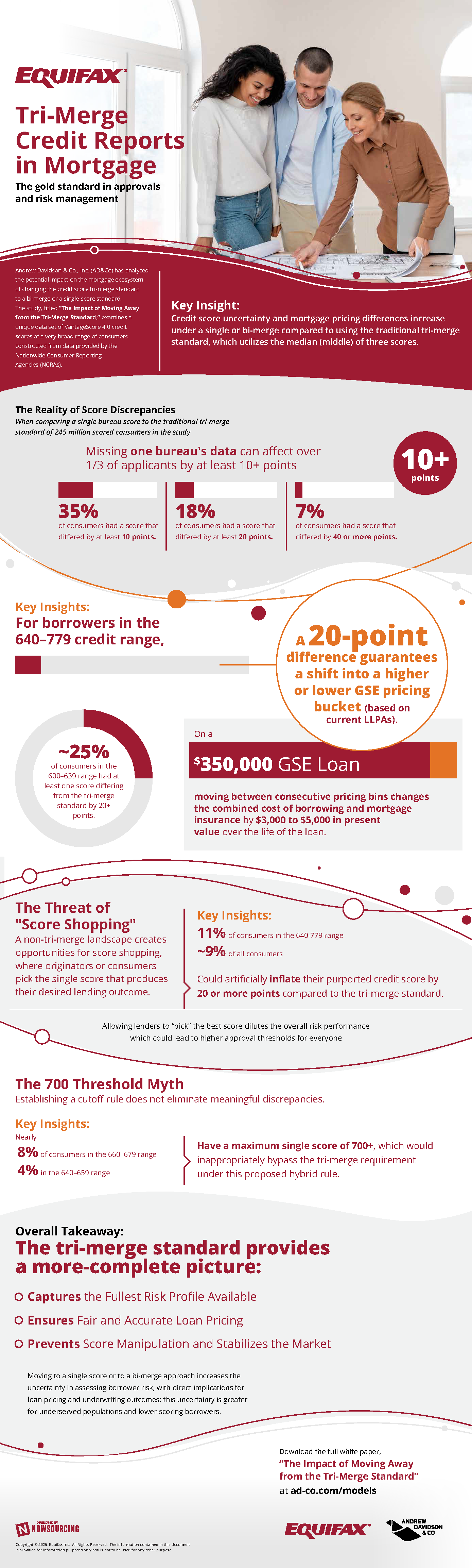
Source: Equifax
